Common Name: SOAPBERRY FAMILY Habit: Tree, shrub, [woody vine]. Leaf: opposite [alternate], generally palmately or ternately [pinnately] lobed to compound, deciduous, petioled; stipules 0. Inflorescence: umbel, panicle, or pendent raceme, axillary or terminal. Flower: unisexual or bisexual, radial or +- bilateral; sepals (4)5, free or fused; petals 0, 4, or 5(6); prominent disk between petals and stamens; stamens 5--12, free; ovary superior, chambers 2--3, each 2[1]-ovuled, style short or 0, stigmas 2(3), linear, or 1, unlobed. Fruit: 2(3) 1-seeded mericarps, conspicuously winged, or generally leathery, generally 1[many]-seeded capsule [berry, nut, drupe]. Genera In Family: 150 genera, 1500 species: +- worldwide. Note:Acer traditionally placed in Aceraceae, Aesculus in Hippocastanaceae. Cupaniopsis anacardioides (A. Rich.) Radlk. possibly naturalizing in southern California. Unabridged Note:Acer and Aesculus have traditionally been placed in small families (Aceraceae and Hippocastanaceae, respectively). However, virtually all the traits considered characteristic of these two small families are also found in the closely related large family Sapindaceae, and it seems more reasonable to emphasize the close relationship of the whole group by treating it as a single family, rather than maintaining two small segregate families that differ from Sapindaceae in virtually nothing except opposite leaves (Harrington et al. 2005). eFlora Treatment Author: Alan T. Whittemore, except as noted Scientific Editor: Douglas H. Goldman, Bruce G. Baldwin.
Common Name: BUCKEYE Habit: Large shrub or tree. Leaf: palmate, leaflets 5--7[9]. Flower: petals 4[5], >> sepals. Fruit: capsule leathery. Seed: 1, large. Etymology: (Latin name for a sp. of oak) eFlora Treatment Author: William J. Stone
Aesculus californica (Spach) Nutt.
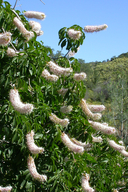
NATIVE Habit: Plant 4--12 m, broad, rounded. Leaf: leaflets 5--7, 6--17 cm, lance-oblong, finely serrate, acute to acuminate; petiole 1--12 cm. Inflorescence: panicle-like, erect, 1--2 dm, finely hairy; pedicel 3--10 mm. Flower: calyx 5--8 mm, 2-lobed; petals 12--18 mm, white to pale rose; stamens 5--7, 18--30 mm, exserted, anthers orange. Fruit: generally 1 at inflorescence tip, occasionally 2--9, 5--8 cm diam. Seed: generally 1, 2--5 cm, glossy brown. Chromosomes: 2n=40. Ecology: Dry slopes, canyons, borders of streams; Elevation: < 1700 m. Bioregional Distribution: c&s NW, s CaR, w edge s SNH, SNF, n&c SNH, Teh, GV (scattered near foothills), n&c CW, WTR; Distribution Outside California: southwestern Oregon. Toxicity: All parts TOXIC. Native Americans used ground seed as fish poison; nectar and pollen TOXIC to honeybees. Flowering Time: May--Jun(Aug) Note: Generally deciduous Jun--Feb. Jepson eFlora Author: William J. Stone Index of California Plant Names (ICPN; linked via the Jepson Online Interchange) Previous taxon: Aesculus Next taxon: Sarcobataceae
Jepson Video for Aesculus californica
Click to watch the video.
Botanical illustration including Aesculus californica
Citation for this treatment: William J. Stone 2012, Aesculus californica, in Jepson Flora Project (eds.) Jepson eFlora, https://ucjeps.berkeley.edu/eflora/eflora_display.php?tid=12026, accessed on April 24, 2024.
Citation for the whole project: Jepson Flora Project (eds.) 2024, Jepson eFlora, https://ucjeps.berkeley.edu/eflora/, accessed on April 24, 2024.
Geographic subdivisions for Aesculus californica:
c&s NW, s CaR, w edge s SNH, SNF, n&c SNH, Teh, GV (scattered near foothills), n&c CW, WTR
MAP CONTROLS 1. You can change the display of the base map layer control box in the upper right-hand corner.
2. County and Jepson Region polygons can be turned off and on using the check boxes.
(Note: any qualifiers in the taxon distribution description, such as 'northern', 'southern', 'adjacent' etc., are not reflected in the map above, and in some cases indication of a taxon in a subdivision is based on a single collection or author-verified occurence).
Data provided by the participants of the
Consortium of California Herbaria.
MAP LEGEND View all CCH records All markers link to CCH specimen records. The original determination is shown in the popup window.
Blue markers indicate specimens that map to one of the expected Jepson geographic subdivisions (see left map). Purple markers indicate specimens collected from a garden, greenhouse, or other non-wild location.
Yellow markers indicate records that may provide evidence for eFlora range revision or may have georeferencing or identification issues.
READ ABOUT YELLOW FLAGS
CCH collections by month
Duplicates counted once; synonyms included.
Species do not include records of infraspecific taxa, if there are more than 1 infraspecific taxon in CA.
Blue line denotes eFlora flowering time (fruiting time in some monocot genera).